
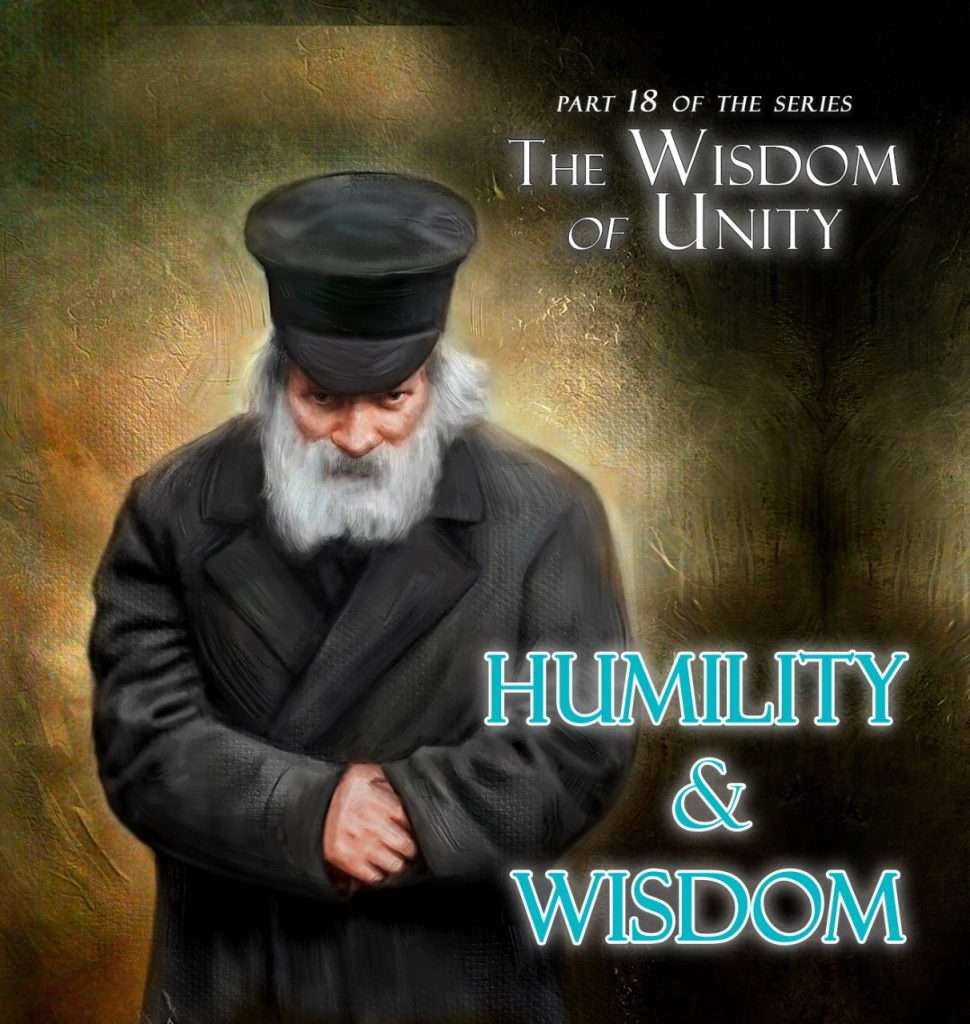
Humility and Wisdom
The Holy Chofetz Chaim says clearly that the cause of Exile is exactly what’s keeping us in Exile for 2,000 years, Loshon Hara. Rebbe Nachman gives us an interesting introspection to help us pick up our way of dealing with this difficult test of character.
Right before Shavuos in the year 1805, Rav Nasan and Rav Naftali, two of the closest students of Rav Nachman, came to him and he said the following. “I know nothing. Just like you don’t know, in the same way, I really don’t know anything at all.”
With great sincerity and a broken heart, he said, “And I have great pity on myself. I feel totally removed from G-d.” Then he said, “All I know is that because of lashon hara in the world tzaddikim can’t be humble.” This is the conversation that preceded the teaching that I want to share with you from Likutei Moharan 197.
Before we actually dive deep into the ideas of Rebbe Nachman, let’s step back and look where we are right now; 2,000 years of exile and look at the state of the world politically, economically. The holy Chafetz Chaim, in the introduction of his work on lashon hara, clearly spells it out. We are in exile because of lashon hara and certainly, learning the laws of lashon hara help.
Right now, we’re in a series called the wisdom of unity, how to bring down the Beis Hamikdash by expanding our consciousness. We want the Beis Hamikdash and the best way to overcome lashon hara is not by fighting our inclination but by picking up our understanding of what causes lashon hara.
We are now approaching the two months of Tammuz and Av, which the AR”I Z”L explains, correspond to the two eyes. Throughout the sections of the Torah that we read in these weeks, there’s a negative cycle of situations where individuals were fooled by the external appearance of what was going on.
Beginning with Miriam’s miscalculation of the elevated level of prophecy of her brother Moshe, which led her to speak out against Moshe, Rashi clearly connects this to the story of the spies who saw what happened to Miriam and didn’t learn their lesson. The spies went after their eyes and gave a disparaging report about the land, which caused all the Jewish people to cry on the night of Tisha B’Av, and we’re still crying 2,000 years of exile, through the vicious cycle of lashon hara.
After the morning prayers, there are six verses of remembrances that many hold as mitzvot to say daily. One of them is to remember what Hashem did to Miriam. Says the Chafetz Chaim, it’s a mitzvah to say out loud, but more than that, a person has to introspect, hitbonenut. You can’t heal something by putting a Band-Aid on.
The problem itself is looking externally at the world. In order to make a rectification, we have to delve deep. This is what the Chafetz Chaim means. This is the beauty of learning Chassidus which is based on Kabbalah. One needs to go deep to the root in order for us to rise above the problem, to go out of exile into ge’ulah, redemption.
Teaches Rebbe Nachman, you should know that through lashon hara in the world, malicious speech, this undermines humility, that through slander that people speak in the world, it’s impossible for the tzaddikim to be truly humble. Lashon hara creates a pirud, a separation between the two character traits of humility, anavah and wisdom, chochmah. Because of this blemish to humility, it’s impossible for them to be truly humble.
Even if somebody wants to be humble, it will be without wisdom. It’s known that humility without wisdom is nothing, for the real virtue of humility is certainly not when a person goes around with a bent-over head or behaves in a foolish manner, as if he’s humble. This is false humility for the essence of humility is when it’s with wisdom.
This, teaches Rebbe Nachman, was the great virtue of Moshe Rabbeinu, that the Torah itself praises him that he excelled in the virtue of humility, that even lashon hara did not undermine his humility, as it says that Miriam and Aharon spoke against Moshe. So it turns out that there was lashon hara in the world and nevertheless, the next verse says, “V’ha’ish Moshe anav me’od,” and Moshe was exceedingly humble. He was on such an advanced level of humility that even slander did not undermine his humility.
The commentary of the Alshich will help us open up this teaching of Rav Nachman. He explains it the way the world is. When a person is accused of something, nature has it that a person has to respond, to reveal the truth. People shouldn’t make a mistake, especially if I don’t answer them. What will people think?
Therefore, in this situation, in theory, it was fit for Moshe to answer, but before he does the Torah preempts him and tells us that Moshe was exceedingly humble. Why doesn’t he answer? Because in doing so he reveals to the world no one reached such exalted levels of prophecy, not even Avraham, Yitzchak and Yaakov. This was the reason that he had to separate from his wife, through Hashem’s divine directive, because he was on such a high level of prophecy.
This is what Chazal tell us, that when a person shows any signs of haughtiness, then his wisdom departs him. Malicious speech automatically slices between wisdom and humility, but Moshe who is da’as, the wisdom of connection, the force of unity in the world, doesn’t let the lashon hara cause separation and his humility is intact.
Even on a deeper level, the two character traits of wisdom and humility represent the two holy sefirot of chochmah, wisdom and binah, the source of humility, as it says that Moshe only reached his level of humility because Hashem granted him the 50 gates of binah. These two holy aspects of intellect, chochmah and binah, are constantly connected. They’re called aba and ima, father and mother.
Moshe is da’as, connection, a connection between chochmah and binah, wisdom and humility. He mirrors his Creator that we say Motzei Shabbos, everywhere where you find the greatness of Hashem, there you will also find His humility. This is a hint to the idea that the two intellects of chochmah and binah, aba and ima are always together.
Therefore, the punishment for lashon hara is tzara’as. The Zohar explains that the word in Aramaic is segira, which means to be cut off from the lights above, the lights of aba and ima. Therefore, Aharon says to Moshe, I beg of you; let Miriam not be like a stillborn, coming out of the womb of her mother with half her flesh consumed. Once again, a hint to the separation between mother and father, chochmah and binah.
Therefore, the rectification, the tikkun is isolation, to sager seven days, an intense introspection, hisbonenus. This is the rectification, to look deeply into the reasons why we feel impelled to speak about other people. We learn from our holy teacher, Moshe, when there’s slander in the world or any type of unconsciousness in the world, a situation, this is like a ticking bomb, waiting to blow up and the only way that it’s ignited is if I react.
One must know that every single person has his vantage point according to his consciousness. Therefore, it says in Pirkei Avos, “Don’t judge your friend until you reach his place.” The holy Sfas Emes adds on, “And you will never reach his place. There’s only one judge in the world.”
Therefore, before I open my mouth, I have to be very, very careful before I speak out against someone. Even on a higher level, before I defend myself, for maybe the best response is to let Hashem speak for me. True humility is clarity on who we are. All of my wisdom, all of my consciousness and anything that I possess is a free gift. I live to give. It’s for other people.
Lashon hara is a dividing force in the world. It destroyed the Beis Hamikdash. Having expanded consciousness, da’as, is unifying. With the help of Hashem, by us internalizing these ideas surrounding this amazing story of Miriam and the humility of Moshe, may we bring down more unity into our lives and shine it into the world. May it be a rectification for all the separation, the pirud in the world and may we merit to see the Moshiach, the ge’ulah and the building of the third and final Temple speedily in our days.