
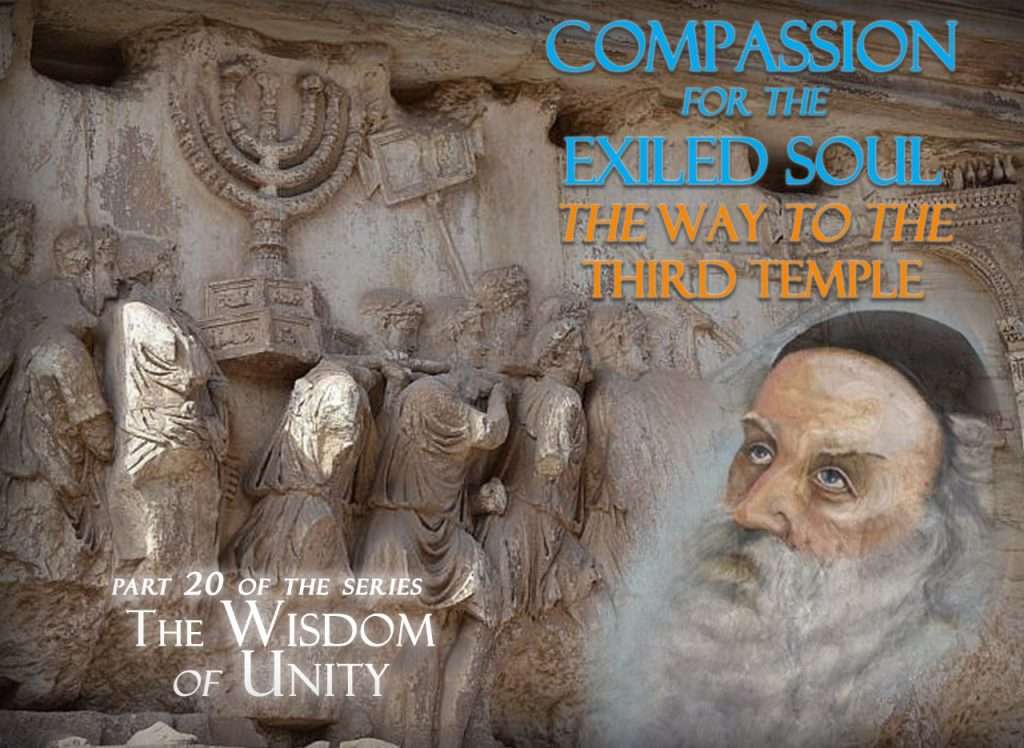
Compassion For The Exiled Soul part 1
The Baal Hatanya gives us a paradigm shift to lift up our consciousness and raise us out of Exile. By revamping our own self image we can also arouse compassion for our fellow brothers. This is a straightforward way to help us fulfil the all-inclusive Mitzvah of Love Your Brother Like Yourself.
This Podcast is the finally in the series The Wisdom of Unity. Due to the length of the material, it will be divided into bit size pieces.
No matter who you are, where you live, somehow, some way, some day, you’ve run into Chabad. They’re there in China for the businessman who needs kosher food, or an Israeli student traveling in India who finds out that today is Sukkos and it’s time to shake a lulav and an esrog. Recently, my sonsinlaw were stuck on Friday in an airport in France. Who did they call? Chabad.
They picked them up and provided for them a place for the whole Shabbos. What’s their motivation? One word, love. That’s what I want to share with you right now, a piece from the Baal haTanya, Rav Shneur Zalman of Liadi. It’s a real life changer. It’s a paradigm shift to lift up our consciousness, to raise us out of exile.
In Chapter 32 of Tanya, in his own words, he prepares for us a way to fulfill the mitzvah of v’ahavta, “and you shall love your brother like yourself.” In order to understand love, the keys to going out of exile and open the doors of redemption, we must understand well the opposite, the flip side. Don’t hate your brother in your heart, which Chazal teach, is the root of the destruction of the Second Temple and the reason we’re in galus today.
We are now in the three weeks, the nine days. Bein hametzarim, between the straits. Historically dark days for the Jewish people. The tendency is to want these days to blow over. Waiting for the Days of Will, Yomei Ratzon, the Yomim Tovim, the good days, the High Holidays. According to the deepest secrets of Kabbalah, in the darkness is the greatest light.
Like I always say, where there’s problems, there’s opportunities. Rectifications, tikkunim. We like to ignore problems, or react, or fight our problems. We said from the onset, someone with wisdom, with da’as, responds to his problems. He recognizes the problems are Gd sent. Messages from Shamayim. If we choose the proper response, we grow spiritually, and that’s the purpose of life, and that’s why life is full of problems. Thank you, Hashem.
So let us go to the source. Let us learn inside what is causing our exile. If we understand the source of our exile, we have a chance to make a rectification, make a tikkun and redeem ourselves. So let’s go to the source. The Gemara in Yoma, Page 9B.
The Gemara clearly says that the First Temple was destroyed because of what I call the big three: idol worship, promiscuity, and bloodshed.
On the other hand, the Gemara says the Second Temple, they were righteous. They were busy learning Torah, doing mitzvos and good deeds. Why was it destroyed? Because of baseless hatred. Therefore, the Gemara equates the big three with baseless hatred.
Why is sinas chinam, baseless hatred, so powerful? So destructive? There’s lots of meaningful commentary on this important piece of Talmud. I want to focus on three that are pertinent to our subject matter, the wisdom of unity. If we can understand well this transgression, only then can we hope to make a tikkun, a rectification.
One of the three reasons is hinted or I might say hidden in the continuation of the Gemara. The Gemara says in the generation of the First Temple, their transgression was revealed, and therefore, the end of the exile was also revealed. Meaning to say that because their transgression was so big, they were aware of their transgression. They also connected the dots and understood that the exile was because of their transgression, and therefore, Hashem revealed to them when the exile would end. When that time came, they did teshuvah and they were redeemed.
On the other hand, during the Second Temple, their transgression was hidden and, so too, the end of their exile was hidden. If I must say, that’s why we’re still in exile today. They were not aware of what they did. For baseless hatred is embedded deeply in the heart. That’s why it’s so tricky, especially for a generation that’s busy with Torah and mitzvos. It’s so easy to point the finger at the other people and say you’re putting a hole in my boat. You’re the problem, and I’m the victim. So the first reason is that baseless hatred is deeply hidden. So much so that it can be written in the Gemara and still remains hidden.
The Chofetz Chaim in the introduction his sefer on lashon hara explains to us the second reason. Baseless hatred is the motivating factor for all other transgressions. Just like we said about the mitzvah of v’ahavta, “and you shall love your friend like yourself,” is an allinclusive mitzvah that the whole entire Torah is based on, the opposite is true with baseless hatred. It is a transgression that’s allinclusive. It’s the root of all transgressions.
Finally, the third, the RaN explains that unlike the big three that only happened from time to time, the nature of baseless hatred is it’s tamid, constant. This is the exact opposite of da’as, the wisdom of unity, the wisdom of constant connection.
Now, there’s a general rule. Something that’s constant is very, very powerful whether it’s from the side of holiness and, Gd forbid, the opposite, the other side. It’s possible for a person to be in a constant state of war with the entire world. Unfortunately, you might know someone who got this bug in his head about someone or something, that even when that person or situation is not in front of him, he’s still at war. This ongoing disdain within keeps the fire going tamid. Like the eish tamid, the ongoing fire in the Beis HaMikdash. This term is a major motif in the Temple, where the Kohanim were constantly present, on guard to preserve its connection of holiness. There’s the korban tamid, the daily sacrifice; there’s the ner tamid, the eternal lamp; there’s the lechem hapanim, the showbread that was in front of Hashem tamid, all the time.
When the Beis Hamikdash was destroyed, the tzaddikim are always connected to Hashem, providing an everlasting connection back to the Temple. As we mentioned in our discussion about Rabbi Shimon bar Yochai, who testified about himself on his final day, “All of my days I was connected in one connection with the Holy One, Blessed Be He.” Finally, Gd willing, we’ll come back to the concept of how the midnight prayer, tikkun chatzos is also an aspect of constant connection.
So let’s summarize. Why is baseless hatred so powerful, so destructive? Number one, it’s the exact opposite of love. It’s the root of all transgression. It’s allinclusive and it’s the flipside of loving your brother. The second thing we said, it’s hidden. Because it’s hidden, it’s very, very tricky. Finally, the third reason, it’s constant, and therefore, very, very powerful.
Because there’s so much material, I’m going to divide it into bit size chunks. If you don’t have enough time to listen to it before Tisha B’Av, because the material is all about building the Third Temple, it’s totally permissible to learn and listen to this on Tisha B’Av itself. The ideas here bring our series full circle. This is one long teaching about da’as, the wisdom of unity, the wisdom of connection.
In truth, all 20 parts of this series is about rebuilding the Temple. As we said from the onset, great is da’as and great is Beis HaMikdash. Both are mentioned in verses surrounded by Hashem’s names, coming to teach us that anyone who possesses da’as, the wisdom of unity, it’s as if he built the Temple in his days.
With Hashem’s help, next time we’ll dive into Chapter 32 from Tanya.