
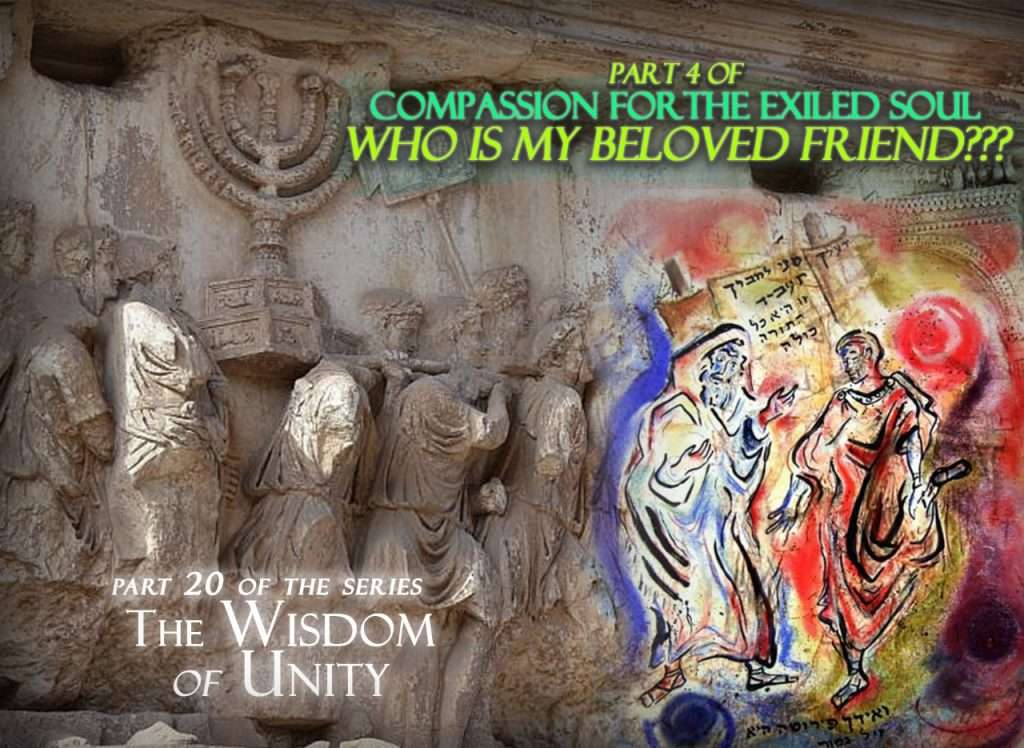
Who is My Beloved Friend?
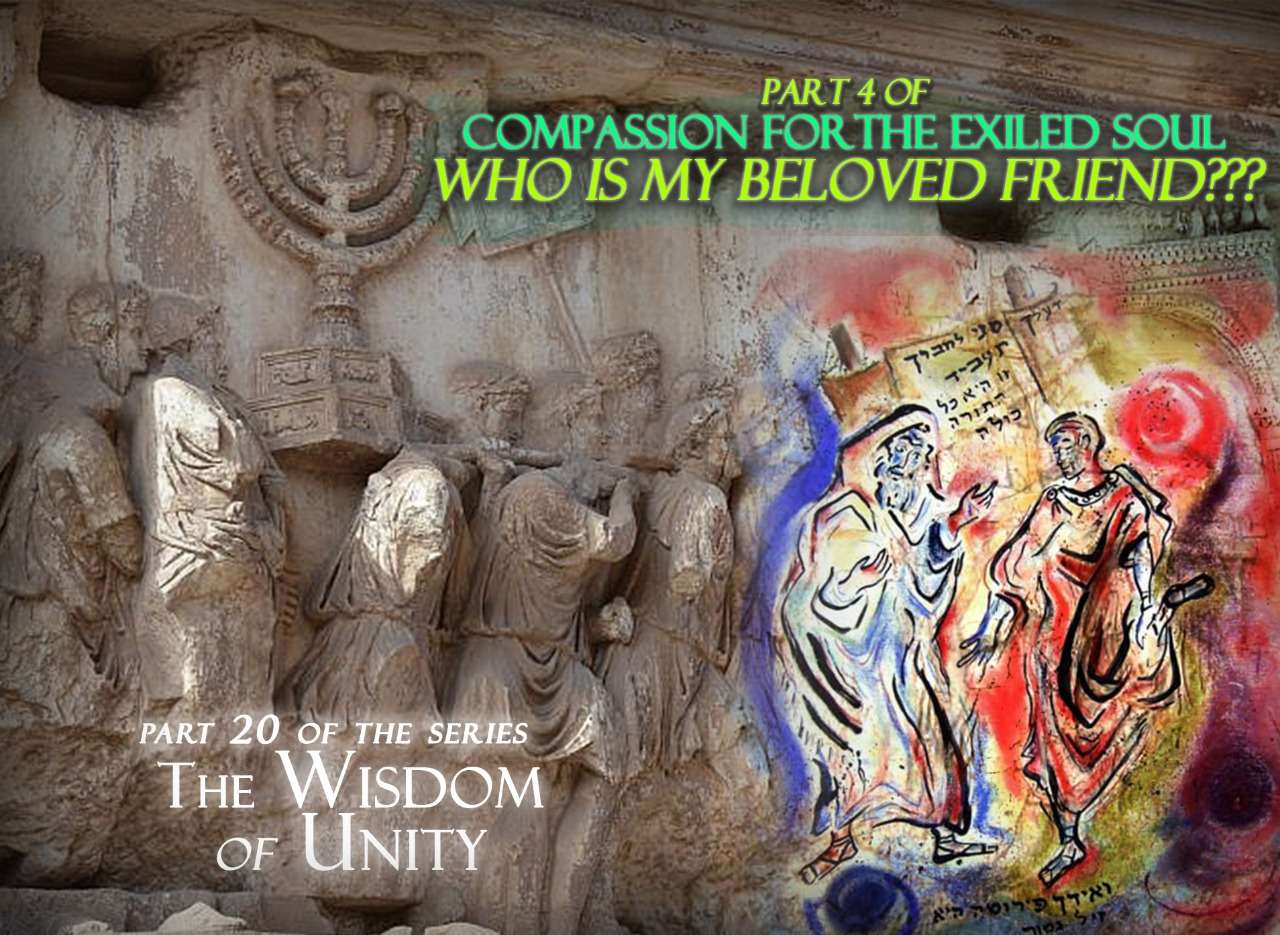
Who is my beloved friend? In order for one to fulfill this all- inclusive mitzvah, we have to know the subject of my love. So as I hinted to last time, there’s another possible answer, novel, not so well known, and G-d willing a really amazing story too.
Before we get started, let’s center ourselves. Let’s get serious about this series, The Wisdom of Unity. Consider being open to new ways of thinking, especially as we turn the final corner and G-d willing, get into the kabbalistic, mystical outlook on redemption. Specifically now, we need to open up a bit, for the reason we’re stuck in exile is because our consciousness is constricted. Be open to expansion. We’re trying to raise up our present level of thinking, pursuing lofty ideas, the gate to redemption, the way to the Third Temple. So consider stretching your consciousness.
Be open to new ways of thinking, just like the person who came to Hillel. He was simply saying I don’t know, please teach me and Hillel gave him a portal, a way to begin. But on the other hand, when our software, our mind system, is programmed by ideologies other than the Torah, he is going to project that out into the world and most likely step on a lot of people’s toes on the way because without the Torah, a person is unconscious.
So who is really this beloved friend? Up until now, we’ve understood that the recipient of my love is someone, my brother, my neighbor. Last week we said my spouse, and that makes a lot of sense for the verse, and you shall love, is in the section of the Torah, which is full of prohibitions, don’t dos. Don’t take revenge, don’t steal, don’t commit adultery, the mitzvahs between you and your fellow brother. And hence, that’s why Hillel said what he said, in the negative. That’s all true and it’s all good. It’s the golden rule. It’s very popular, but that’s Rashi’s second explanation.
The problem with learning that way, the Torah’s not just pieces of advice of how to get along with my fellow man. A majority of the Torah are mitzvahs between a person and his Creator and therefore, the number one way to understand who is really my beloved friend? Hashem. Now we can better understand the story of Hillel.
Listen to the holy words of Rashi. He brings a verse from Mishlei, your friend and your father’s friend. Meaning to say the friend of the Jewish People today, and the friends of your ancestors. Rashi continues, just like you don’t enjoy when someone ignores you — you know sometimes it happens, people ignore you — so too, don’t ignore Hashem. The whole entire Torah is Hashem’s will. Now it makes total sense what Hillel said to the perspective convert. In the general way, that’s the way we view the Torah. The rest is an explanation. Go and learn.
This week’s Zohar, Va’eschanan, calls the mitzvahs of the Torah, the 613 good pieces of advice. Torah teaches us the path of truth and anyone that lets go of the Torah, it’s like letting go of life. On the other hand, our minds are full of ideas, foreign ideologies, much of it from the West, but Eastern too.
Listen to this amazing story to illustrate how loving Hashem, and that means loving the will of Hashem, the Torah, helps me love my fellow brother, to live with consciousness. This is a true story about a young Israeli woman from a secular home, and she had just finished her service in the IDF. Like thousands of Israelis, she took the year off and went backpacking in India. She calls home, and with great enthusiasm, informs her parents that she has found real spirituality in India. Unfortunately, in the Holy Land, spirituality didn’t find her.
Anyhow, she told her parents she is coming back home for a few days to drop off her valuables before she takes her vows of asceticism and she is moving into an ashram, a life of fasting, meditation, and celibacy. No lawyer son-in-law, and no grandchildren. Despite her excitement, her parents were beside themselves. And what do all good secular Jewish parents do when they get such a call? They call the rabbi.
The organization Arachim moved into action, and they informed the parents that their ace lecturer was giving a class right next to their home, and they promised that within 15 minutes, she would change her mind. What they didn’t tell them, was that most likely she would want to enroll in a religious seminary, but that’s better than India.
So when she got home, out of respect to her unenlightened parents, she agreed to attend the lecture. The three of them were sitting in the packed auditorium waiting for the rabbi to arrive. Fifteen minutes, 30 minutes, and he doesn’t show. Then all of a sudden, a young man from the audience gets up and says, so the night shouldn’t be a total loss, I would like to share with you something I learned today on the laws of returning lost objects. The parents were squirming in their chairs. A lost opportunity. One night to save their daughter.
So the young rabbi starts to go into all the details of the laws. One finds, for example, a wallet. Does it have cash? Does it have identification? What should he do? When is he allowed to keep it? When does he have to give it back? How does he have to give it back? She listened. It was interesting, but not life changing. In the eyes of her parents, it was a disaster.
So to make a long story short, the rest of her trip was uneventful. She got on the plane and returned to India. One of the elders of the ashram came to meet her at the airport and lo and behold they find a wallet, and when they look inside, there’s cash and they both looked at each other and the elder said one word. Karma.
Don’t get me wrong, I don’t have anything against the concept of karma. I definitely believe in divine providence, that Hashem watches over everyone and everything. And she looked at him and says, but there’s identification. And he said, karma.
Because she had learned a little bit of Torah, the will of Hashem, just the truth about lost objects, she was clear that the proper thing to do was to return the wallet and not to use karma as an excuse to steal. But even more important, this was real divine providence, real karma. Therefore, she understood that the proper thing to do for her was to return home, return her soul from her exile to the place it belonged.
The more you learn, and you try and put into practice what you learn, the more you see that it’s eternal, it works, and it always brings a smile to the world because it’s the Creator’s gift to mankind. Ultimately, when one really, really loves Hashem and is very, very careful to try and understand everything he can about his beloved friend, then ultimately, he is crazy about his kids, and he knows the true way to live among them and treat them with respect according to the Torah. But on the other hand, without that good advice, a few words can be so destructive. With one seemingly innocent conversation, you can ruin another person’s livelihood. With one negative comment, you can discourage a person from his life’s mission. For life and death are in the power of the tongue.
Midah tovah merubah, the side of good is much more powerful than the darkness. With a good word, even with a smile, a person can bring somebody back to life. When our minds are full of the wisdom of the Torah, the will of our beloved friend, then he is full of compassion for all of creation. He is awake, conscious, careful in all of his thoughts, words, and actions, and projects lovingkindness into the world. Let’s always remember the advice of Hillel, the golden rule, just like you don’t like to be ignored, all we got to do is not ignore the good advice of our beloved friend, Hashem.