
The Golden Rule on One Foot
Let’s get practical. How does one fulfill this allinclusive mitzvah of loving another like yourself? It’s big. It’s important. It’s a klal gadol, the whole entire Torah. So today, once again, I want to go to the source, the Talmud. The famous story of Hillel and the prospective convert, but before we get into the story let’s just summarize. Because hinted in what we already learned is the key to what we are about to see today.
According to the Baal HaTanya in Chapter 32, the way you view yourself will greatly affect the way you view others. If you’re focused on your negative side, you’ll be a very unhappy camper. This causes disdain. Some call it hating the world. We said, why is baseless hatred so destructive? Because it’s the root of all transgression. It’s 247, tamid, always. It’s the exact opposite of the Beis Hamikdash. On the other hand, if we focus on our good, our godliness, our soul, even if we aren’t 100 percent, we’ll have compassion on ourselves and others.
This is a major foundation of the teachings of the Baal Shem Tov, and we find it in countless places in the writings of his students. For example, the Me’or Einayim in Parashas Chukas, somebody that sees negativity in another, it’s like looking in a mirror. If his face is dirty, he will see dirt in the face in the mirror. He brings our verse, v’ahavta. What’s it mean, k’mocha, like you? Just like you wouldn’t hate yourself, you wouldn’t hate another. I guess in the times of the Baal Shem Tov, people at least loved themselves.
This idea of projection, that what you feel in your heart is what you put out into the world, is in this week’s Parashah, Devarim. Baruch Hashem, right before Tisha B’av all of us are on one page, finally. At the end of the first chapter in Sefer Devarim, Moshe recounts the story of the spies and the response of the Jewish people. You spoke lashon hara in your tents, and you said because of Hashem’s hatred for us did He take us out of the land of Egypt. What does Rashi say? He loved you, but you hated Him. As the popular saying says, that which is in your heart about your friend is what you think in your heart about you. Wow.
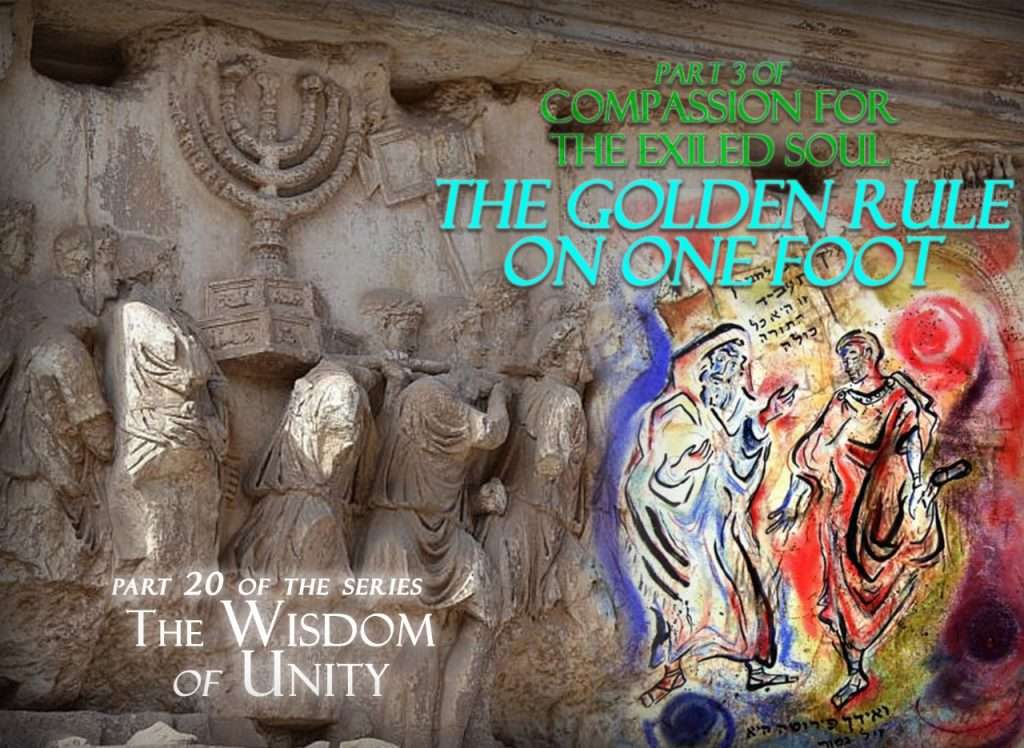
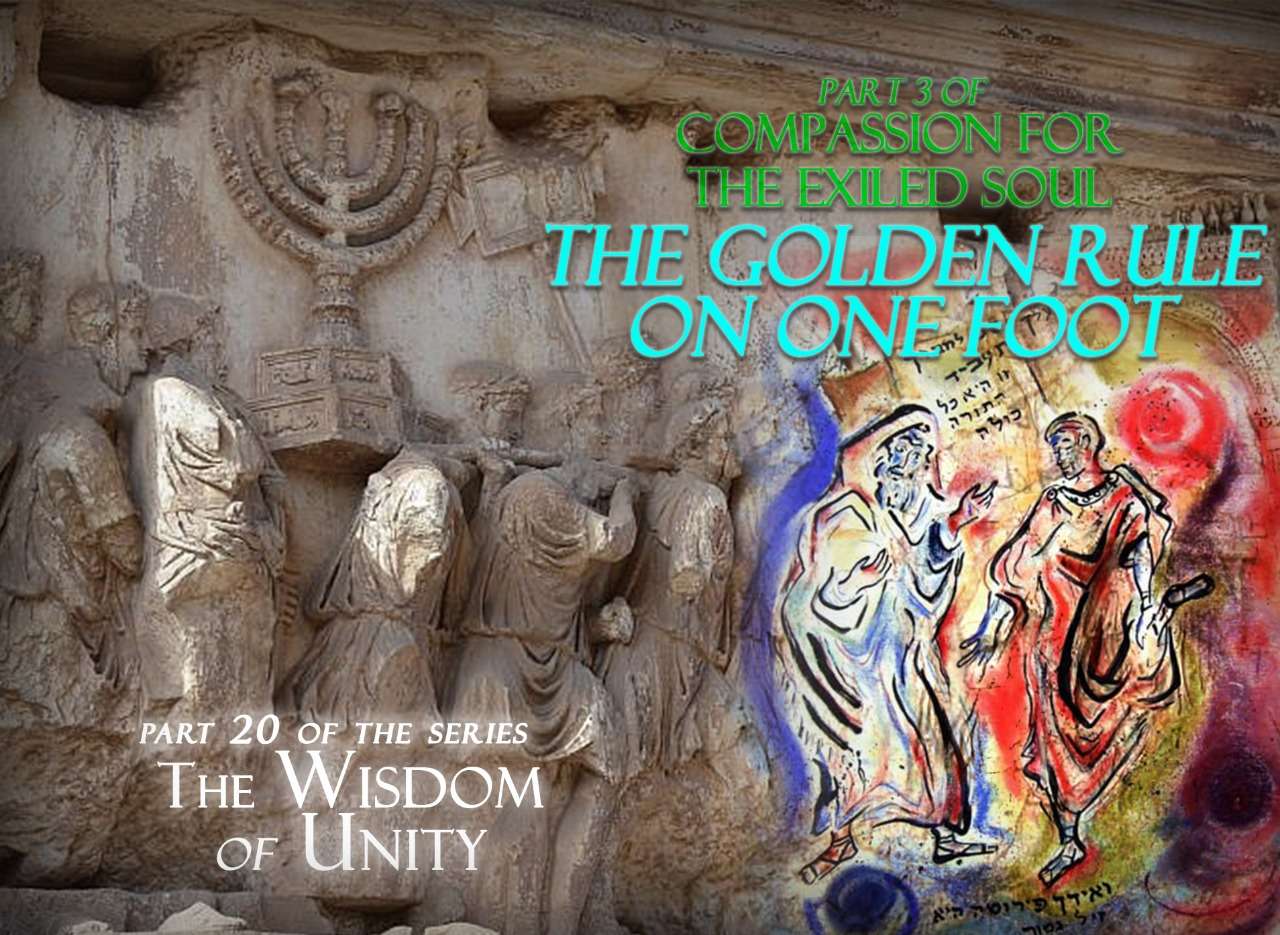
So let’s go to the Gemara on Shabbos, 31 A, the famous story of Hillel. After getting a bump on his head from Shammai, a prospective convert came to Hillel with the following proposition. Convert me on the condition that you teach me the entire Torah while I’m standing on one foot. Hillel converted him and he said to him what the world calls the golden rule, that which you dislike don’t do to another. This is the entire Torah, and the rest is just an explanation. Go and study.
What’s really happening in this encounter? Who is this potential convert? What if I’m already Jewish? Why did he ask him to teach the whole Torah on one foot? What does that mean? Why did Shammai hit him over the head?
Everyone agrees that what Hillel’s teaching, is our verse, v’ahavta, and you shall love your brother like yourself. Why did Hillel choose to teach in the negative and why did he include the feelings of the person, what you dislike? What did he mean to say, go and learn Torah? Who is this beloved? The Kli Yakar. On our verse, v’ahavta, you shall love, in Vayikra, Chapter 19, Verse 18, gives us a way to understand many of the answers to these questions.
The reason this prospective convert wanted to understand the Torah on one foot was because he was a newcomer. He wanted an easy way to enter into the world of Torah. One mitzvah that sums it all up. A portal to the Torah. A door to rise up out of the exile of the soul. To transcend being selfcentered, living in the world of separation.
Shammai, according to Kabbalah, is coming from the side of strict justice. He was a huge Torah scholar that toiled day and night to perceive the 613 mitzvahs of the Torah.
It was ludicrous to try and sum up the Torah in one mitzvah, but Hillel in his humility and lovingkindness lowered himself down in order to connect with this person out of his compassion for the exiled soul. For no matter who we are, at birth we’re born unconscious and that means we’re in exile. Because we lack wisdom, because we’re unconscious, even though we look like we’re created in the image of Gd, but we’re more like an ox bumping into people and stepping on toes.
Shammai looks at such a person and bops him over the head. Hillel in his humility and lovingkindness has compassion on the exiled neshamale. Hillel first tells him to get clarity on what he dislikes. That’s the nature of a human being, to easily get ticked off. Everyone knows what it feels like when somebody steps on their toes. He could relate to that. That’s our starting point, recognizing what hurts me. Only then could I understand what hurts another person. That’s also why he puts him in the formula and uses a negative instead of love.
Selfknowledge is a prerequisite to being able to make the quantum leap to really connect with another human being. Lack of clarity in this area is often what makes a person feel unfulfilled, unhappy, and project our negativity out into the world. You can’t succeed if you don’t have a target. Often, when we put our head on the pillow, we can’t actually say that our day was fulfilling. This is exactly what we said earlier. If you lack clarity inside about what you like and dislike, that’s going to greatly affect your relationship with the rest of the world. Even at the level of a great sage like Shammai, his strict approach to himself was projected out onto the prospective convert, which ended in a bop over the head.
Don’t get me wrong. We love all rabbis and especially Shammai, but in the continuation of the Gemara basically, it says what I said, just in different words. So practically speaking, the first step is to recognize that I’m in exile and try and connect with somebody that has wisdom, da’as. That can help emancipate me. The second thing we learned from this story, is not to be discouraged even by rabbis who are coming from the side of strict justice. Persevere and find someone with wisdom and compassion. The third thing is to get clarity, what you like and don’t like and immediately stop doing it to other people.
Okay, now, who’s this beloved? Who’s the person I’m supposed to love? Now, we’re really going to get practical. This is serious work. This is not easy. One needs to find a partner and the best place to start is at home with your spouse and there’s even a hint to this from the Talmud itself. The verse, and you should love, was mentioned a handful of times in the Talmud and several of them have to do with a husband and wife.
First, selfknowledge. Make a priority list of your top likes and dislikes and write it down. Otherwise it’s a gray area and it’s not clear and then you have to learn how to communicate and that’s not easy. This is the portal to connecting yourself with the rest of the world and the best place to begin is at home. Baruch Hashem, me and my wife are already using this on our marriage and to help other couples and it works. With Hashem’s help we’ll see next time, another explanation of who that beloved is.
Finally, why did Hillel tell him to go learn Torah? A person that truly wants to elevate his soul from exile is constantly learning Torah. For the Torah is meshivas nefesh, it returns the soul. It elevates the soul, daily uncovering new ways to expand our consciousness, refining our behavior, and connecting on a more profound level with humanity.
The mitzvah of you shall love is like a ladder that begins in the ground and reaches to the high heavens. In the beginning it starts with not damaging people, but the Rambam in Hilchos Dei’os explained, that really on a higher level, it has to do with giving, loving. This mitzvah is infinite. It begins on the ground with not stepping on people’s toes, but the very top of the ladder is the redemption itself. Unity, love, and compassion, and finally the student is elevated to the level of the sage.
Be like Hillel. For the greatest gift you can do for anybody is to shine into him da’as, the wisdom of unity, the wisdom of connection. Then there’ll be great mercy and compassion in the world, and it will arouse the mercy of Hashem and then the verses of Isaiah will come about. There won’t be strife or division on my holy mountain for the world will be full of the wisdom of Hashem like the waters of the sea. I will bring you to my holy mountain and there you will rejoice in my house for my house will be a house of prayer for all of the nations. Amen.